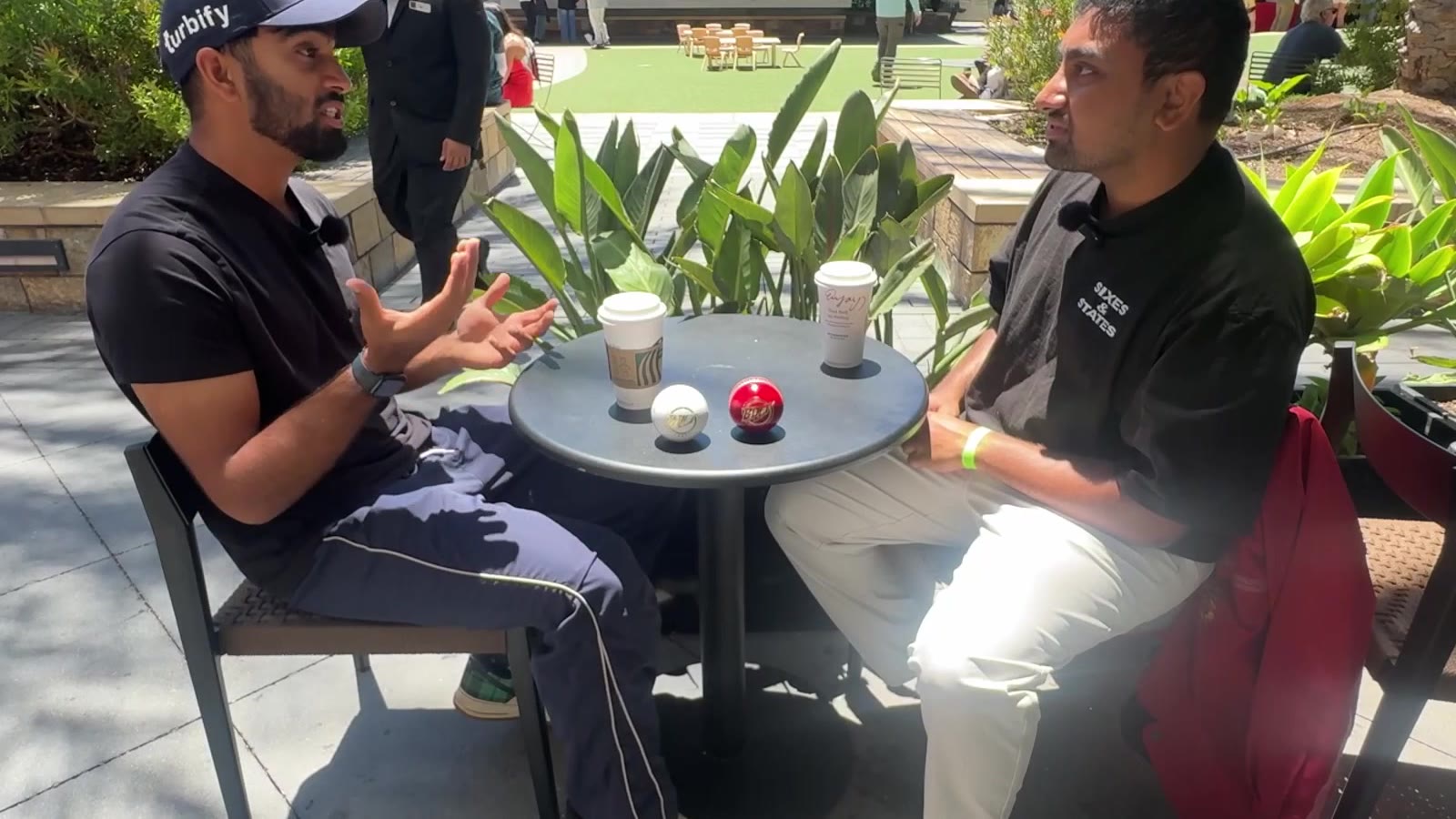
More from Sixes and States. This feature comes from Amal Bhatnagar’s interview with Abhishek Paradkar for Sixes and States. Watch our full interviews on Sixes and States on YouTube, and follow @sixesandstates on Instagram and TikTok.
A year after surgery on his ankle, Abhishek Paradkar walked back into the nets to bowl again. His first delivery flew over the top of the net.
“I remember I was in tears that day,” he told Sixes and States. One question kept running through his head: “You’ve been out for a year, your first ball has just gone over the net. Can you even play professional cricket anymore?”
He could. Paradkar is now a U.S. international and a left-arm pace bowler for Washington Freedom in Major League Cricket (MLC), the country’s top professional league. MLC plays T20, a fast format in which each side bats for up to 20 overs of six deliveries, and games last about three hours. Born in San Diego, Paradkar made his one-day international debut for the U.S. in 2021, according to Wikipedia, and joined the Freedom through MLC’s domestic players draft in 2025, the team announced.
His path runs through three countries and two ankle surgeries. It also says something about American cricket, which he believes is closer to the world’s best than most people realize. He told the story in an in-person interview with Sixes and States in the Bay Area during the 2026 MLC season.
Born in San Diego, raised on cricket in India
Paradkar lived in San Diego until he was about five, when his father found work in India. He started playing cricket at 12, at first as a hobby.
His coaches saw more. “A lot of the coaches in my academy would always bump me up into the senior group,” he says. Playing against older players scared him at first, but “that just gave me confidence that maybe I’m doing something good here.” His father agreed, telling him, “There’s actually something here that you can pursue.”
In Hyderabad, he moved to St. Andrews High School, one of the city’s top cricket schools. He captained the school team and played for his state at under-14 and under-16 level. “Until then, cricket was just a hobby. I never saw myself pursuing cricket as a career,” he says.
“Everyone used to tell me that there’s no all-rounders in the country. You could actually do something. You could actually play in the IPL,” he says, referring to the Indian Premier League.
America came back into the picture when he was about 20 and studying in the U.K. Friends from India, including Sanjay Krishnamurthi, were heading to the U.S. to play. “It just appealed to me because it’s obviously my country of birth,” he says. He joined national camps and played Minor League Cricket, the development league below MLC, while finishing his studies, then moved to the U.S. for good.
The year away
As a teenager, Paradkar played through a sharp pain in his landing foot for a long time. A small piece of his heel bone had chipped off and lodged in his ankle joint. Eventually, a doctor told him he needed surgery, the first of his life.
“It was very tough for me mentally, more so than physically,” he says. He used a walking stick while his peers played for the Karnataka under-19 team.
Rehab tested him most. “It’s just doing the same repetitive things every day, three times a day. You can’t see the light at the end of the tunnel,” he says. He even talked to his coach about switching to spin bowling. “If this is going to be how fast bowling is, I don’t want to do it. I want to play cricket.”
It took almost a year to bowl again, and that first ball sailed over the net. A few months later the pain returned. He played through it for three more years, then had a second ankle surgery in January 2025. Then came the news: “I get to know I’m drafted for the major league.”
“Just one more hurdle”
His advice to injured athletes thinking about quitting is simple. “I tell them just give it one last try,” he says. “Tell yourself, okay, if I want to leave, I will leave at the next injury or at the next hurdle.”
He has thought about leaving the game himself, more than once. “You’re only proving to yourself that you don’t quit. When times are tough, you don’t quit,” he says.
Today he bowls “relatively pain-free,” and he is proud of the work behind it. “Even if I were to hang my boots up today, I would be proud of myself for overcoming multiple surgeries and multiple injuries throughout my career,” he says.
“So I just keep telling myself, just one more hurdle, just one more hurdle.”
The 4 a.m. lunches
“I think my mom and dad have been the biggest rocks in my career,” he says.
“My mom used to wake up at 4 a.m. and make me breakfast for me to be able to eat, get to training by 6,” he says. She packed high-protein meals so he never had to eat out. “She would wake up every single day along with me, earlier than me, to pack my food for the day.”
His parents still live in India. His father flew out to watch him in MLC in 2025, and he hopes his mother can come soon. He visits for a month or two every year and still calls home daily. “She’s very dramatic. If I don’t call her, she’ll be like, did you forget you have a mom?”
“I recognize the fact that I’m trying to do something here,” he says, “but it also sucks to have to make a sacrifice and not be able to see your family.”
Learning from Ponting and Maxwell
His first MLC season put him in elite company. “I couldn’t believe I was in the Coliseum in the dressing room with the likes of Glenn Maxwell, Ricky Ponting,” he says. Ponting, the Australian great, is the Freedom’s head coach, and Maxwell captained the team in 2025, according to Wikipedia.
“They’re such humble, down-to-earth people that you can ask them as many questions as you want,” he says. “I’ve just been pumping Ricky with questions.”
Watching them prepare changed how he trains. “It’s taught me to practice with purpose. They don’t believe in wasted reps,” he says. Now every delivery he bowls in the nets has a plan and a batter in mind. “Once you’re in a game situation and you have to execute that exact ball, you know you’ve done it in practice so it feels familiar.”
“You’re here for a reason”
Each MLC team mixes international stars, known as overseas players, with domestic players from the U.S. In the league’s early years, Paradkar says, “you could see a difference of level between the overseas and the domestics.” Not anymore. “I don’t think the expectations for domestics are any different to overseas players,” he says.
“Every year that MLC has happened, the domestics have only gotten better,” he says. “Good players want responsibility.” He sees the effect on the national team too. “We’re expected to win games now, and that’s purely the effect of the MLC.”
Self-doubt still visits. “It happens to everyone,” he says. His answer is the data. “You have so many data analysts on every team. You have so much data. They’ve seen you. They have videos of you. They have your stats. If you’re not good enough, you wouldn’t be there.”
He uses data in his bowling plans too, balanced with instinct. The stats might say a batter is weak against a certain delivery, but “you still need to back your best ball,” he says. “So I think there’s a place for both.”
What comes next for American cricket
The talent is already here, Paradkar says. “We have our early morning training sessions indoors where you have six or seven major league players coming in and we’re all keen to get the work done,” he says of the Bay Area. “We’re going to make do with what we have.”
The next step is more year-round training outdoors on turf, the natural grass pitches the pros play on. In India and England, he says, kids play on turf from age 10 or 12, “which is why once you get to a professional stage, it doesn’t seem that foreign to you.”
Minor League Cricket helps fill the calendar. “I think just being able to play on turf, for example, for two or three months in the year is golden,” he says. So do new stadiums like the one in Grand Prairie, Texas.
What do people misunderstand most? “People don’t think there’s good quality cricket out here until they actually come here,” he says. “Every new cricketer that has come in the U.S., the first reaction is always a surprise. Cricket is serious here.”
He puts MLC “on par with the biggest leagues in the world.” From here, he says, the league needs to “get more eyes, get more people to watch, get more companies to invest.”
“I’ve played cricket in the U.K., I’ve played cricket in India, I’ve played cricket here. It’s not far off,” he says. “Talent-wise, we’re as good as anyone in the world.”
“I feel like it’s only going to get better from here.”
Follow Abhishek Paradkar and Washington Freedom at washingtonfreedom.com, and the U.S. men’s team at usacricket.org.
Sources
All quotes from Abhishek Paradkar come from his interview with Amal Bhatnagar for Sixes and States, recorded in person in the Bay Area during the 2026 Major League Cricket season. None are taken from other publications. Filler words were trimmed without changing meaning.
- Wikipedia, “Abhishek Paradkar”, accessed Oct. 18, 2026. Born in San Diego; ODI debut on Sept. 9, 2021, against Papua New Guinea.
- Washington Freedom, “MLC 2025: Five domestic players to keep an eye on”, June 12, 2025. Signed in the 2025 MLC domestic players draft.
- Wikipedia, “Washington Freedom (cricket)”, accessed Oct. 18, 2026. Ricky Ponting as head coach; Glenn Maxwell as 2025 captain.